

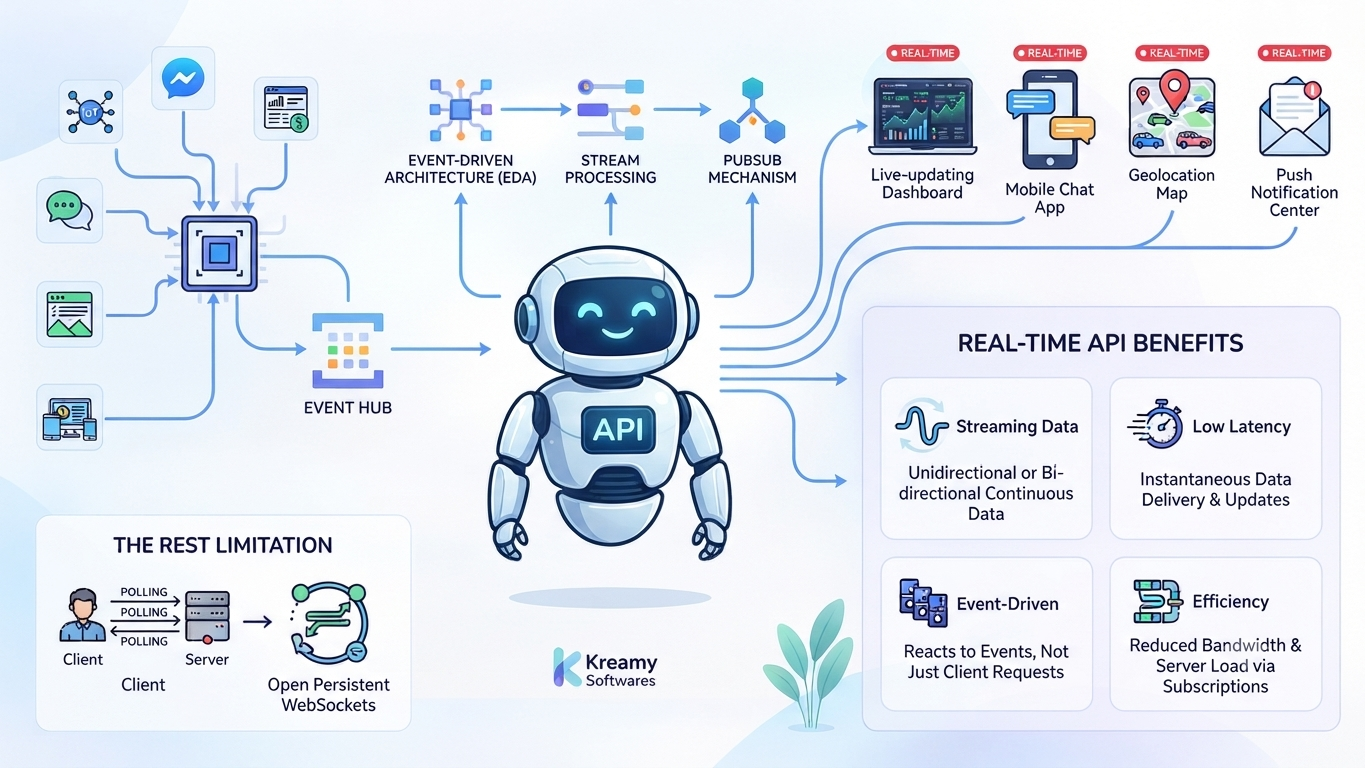
REST has been the default choice for web APIs for two decades, and for good reason — it's simple, cacheable, and universally understood. But REST was designed around a request-response model, and a growing share of modern applications need something REST wasn't built for: continuous, low-latency, bidirectional communication.
Live dashboards, collaborative editors, chat, multiplayer features, and trading platforms all need the server to push updates the moment they happen, not wait for the client to ask. Polling REST endpoints on an interval works, but it wastes bandwidth and adds latency exactly where it matters most.
WebSockets open a persistent, full-duplex connection between client and server, letting either side send messages at any time. They're supported natively in every modern browser, which makes them the default choice for real-time features in consumer web apps — chat, live notifications, collaborative cursors.
gRPC, built on HTTP/2 and Protocol Buffers, shines in service-to-service communication inside a backend, or in mobile clients that benefit from strongly typed contracts and efficient binary serialization. Its streaming modes (client, server, and bidirectional) cover many of the same real-time use cases as WebSockets, with stronger typing at the cost of being less naturally supported directly in browsers.
As a rule of thumb: reach for WebSockets when you're pushing real-time updates directly to a browser-based client, and reach for gRPC when you're connecting backend services or native mobile clients that benefit from strict schemas and high-throughput streaming. Many production systems use both — gRPC internally between services, WebSockets at the edge facing the browser.
See how we approach real-time architecture in our web builds →