

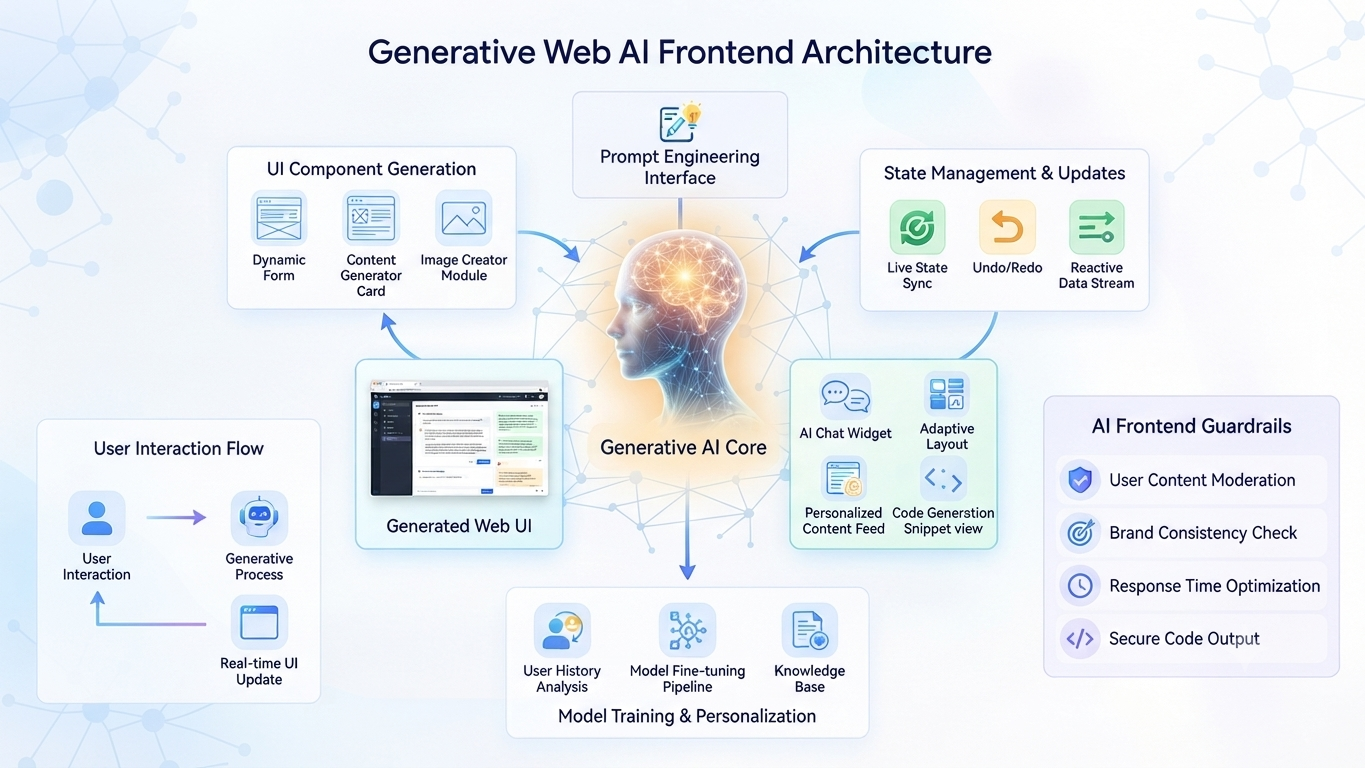
Front-end development has always involved a fair amount of repetitive translation work: turning a design file into markup, wiring up state, writing the same form-validation logic for the tenth time. Generative AI tools are increasingly absorbing that translation layer, changing what a front-end engineer's day actually looks like.
Tools that generate React or Vue components directly from a design file or a plain-language description are closing the gap between design hand-off and a working prototype. This doesn't replace the engineer's judgment on accessibility, state management or performance — but it removes a lot of the boilerplate that used to eat the first few hours of implementing a new screen.
Generating test cases, including edge cases a developer might not think to write by hand, is one of the more immediately useful applications we've seen in practice. AI-suggested tests still need human review — they can be confidently wrong — but they're a genuinely useful first draft.
Design taste, accessibility judgment, and understanding how a real user actually behaves are still fundamentally human skills. Generative tools are good at producing plausible-looking interfaces quickly; they're much weaker at knowing whether that interface is actually the right one for your specific users. The teams getting the most value are using AI to speed up production of a design direction they've already validated — not to make the direction decision itself.
On our own engagements, we treat generative AI tools as a way to compress the distance between a validated design and a working build — while keeping human review firmly in place for accessibility, performance and the judgment calls that determine whether an interface actually works for real users.