

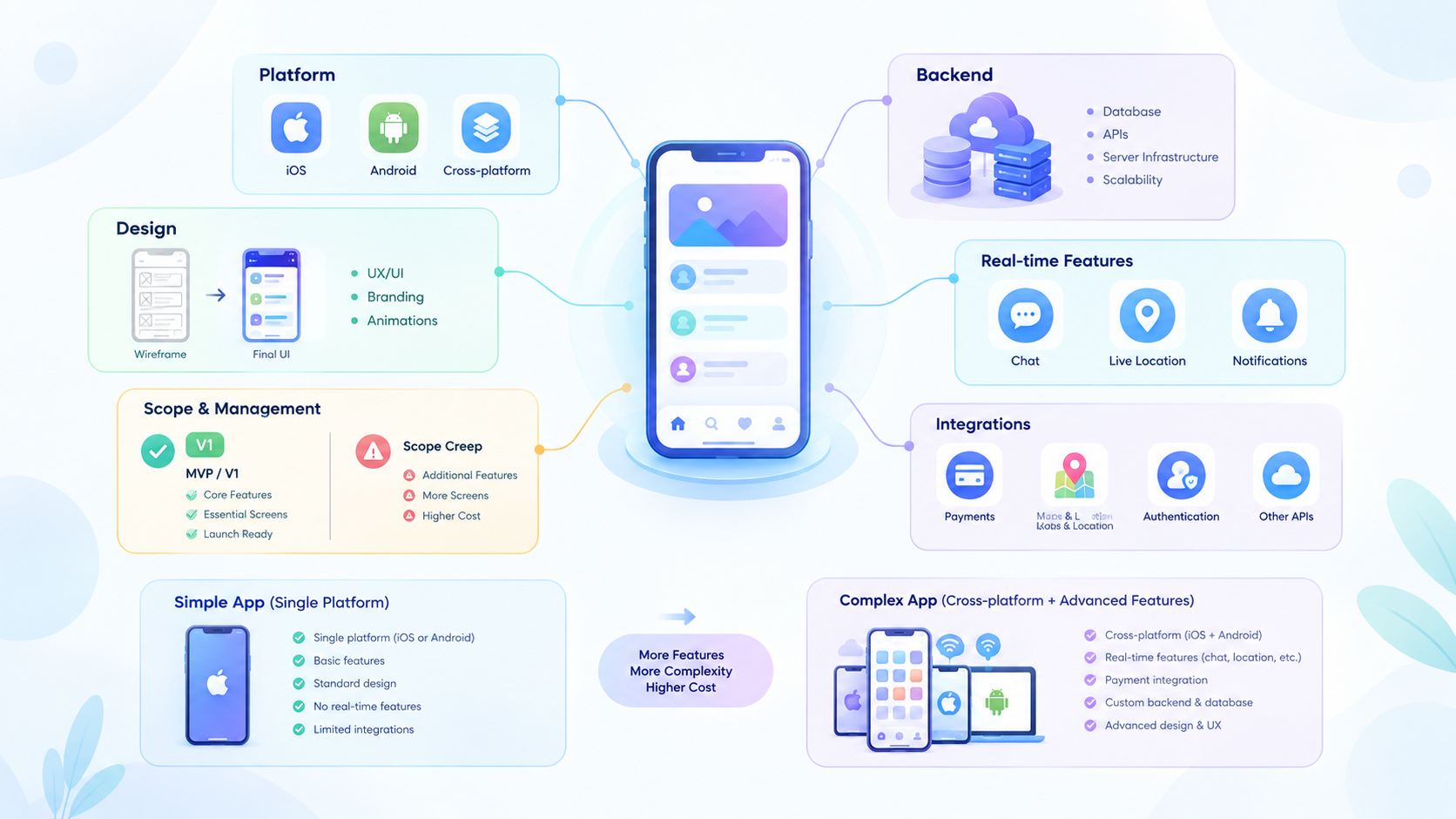
This is the question we get asked first, and it's a fair one — but anyone who gives you a single number without asking you anything first is guessing, not estimating. Here's what actually moves the cost, so you can build your own realistic range before a scoping call.
A simple, single-platform app with a handful of screens and no complex backend can be a few weeks of focused work. A cross-platform app with real-time features, payments, and a custom backend is a different project entirely, often measured in months. The gap between those two is enormous, which is exactly why "how much does an app cost" doesn't have one answer.
Platform choice. Native iOS and Android separately roughly doubles engineering effort compared to a single cross-platform codebase (Flutter or React Native) — worth it when you need deep platform-specific capability, often not worth it for a first version.
Backend complexity. An app that's mostly a frontend on top of an existing API is a fraction of the cost of one requiring a new backend, database design, and business logic from scratch.
Real-time features. Live chat, live location tracking, or real-time notifications add meaningful complexity — these aren't "just another screen," they're architectural decisions that ripple through the whole build.
Third-party integrations. Payments, maps, and auth providers each look simple in a demo and each come with edge cases (failed payments, expired tokens, rate limits) that take real engineering time to handle properly.
Design maturity. Building from a rough sketch costs more in back-and-forth than building from a finished, click-through prototype — investing in design upfront often pays for itself.
The most common overspend we see isn't a single bad decision — it's scope creep during the build, where "small additions" accumulate because there was no clear line for what v1 actually needed. The second most common: building native iOS and Android separately for a product that hasn't validated demand yet.
Skipping proper backend architecture to hit a launch date, then rebuilding it six months later under real user load, usually costs more in total than doing it right the first time — just spread across two painful phases instead of one planned one.
We ask about your riskiest assumption, your target platforms, whether a backend already exists, and which third-party services you need — then we give a real range with the reasoning behind it, not a number pulled from a rate card.