

Every year brings a fresh wave of "this changes everything" AI announcements. Most don't change much for the average product team. A few genuinely do. Here's where we're actually seeing results with clients right now, versus what's still mostly demo-ware.
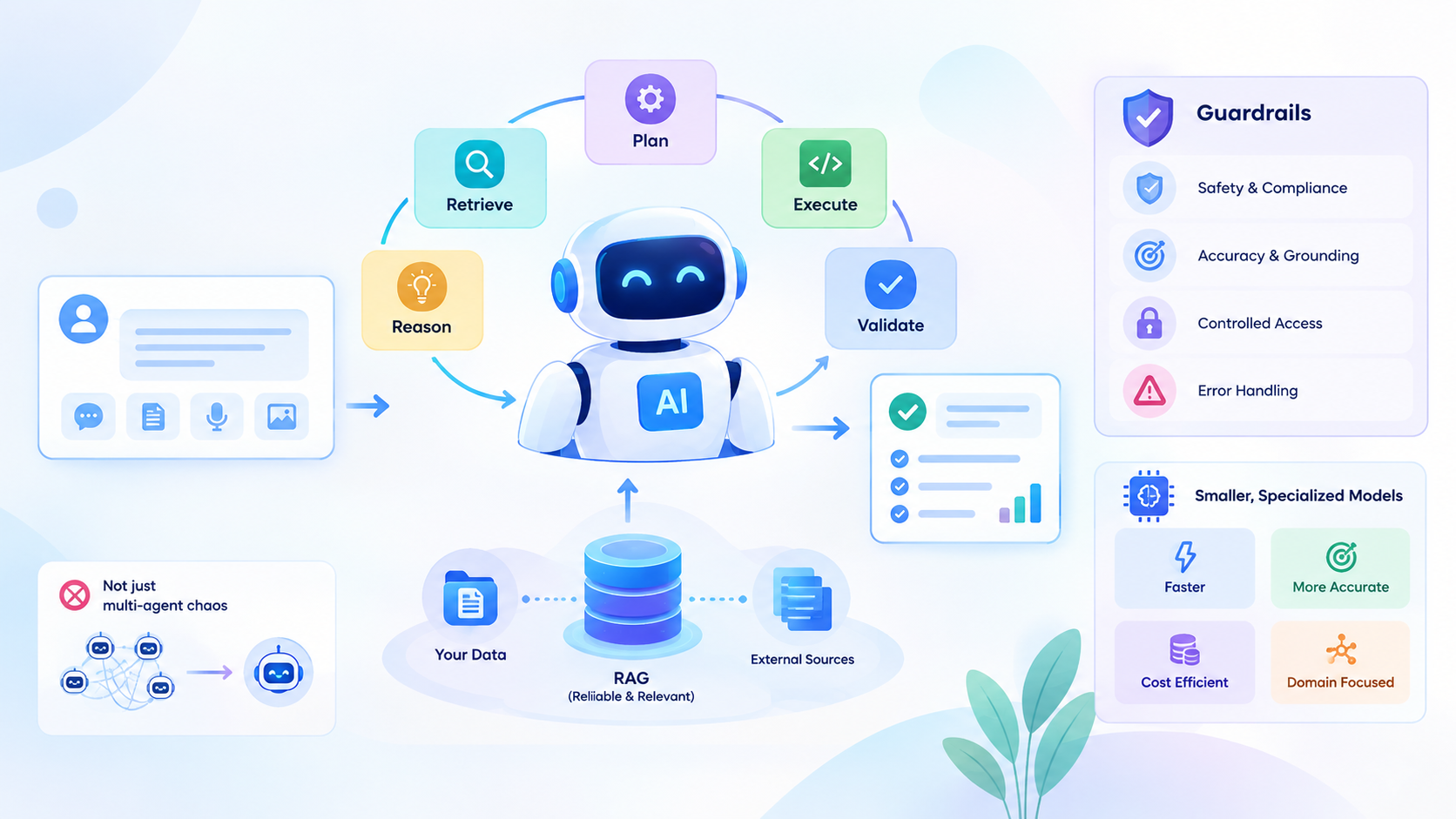
Agentic AI — systems that complete multi-step tasks rather than just answering questions — has moved from research demo to genuinely useful in the last year, but only where teams invested in the guardrails alongside the capability: clear permission boundaries, human-approval checkpoints for anything consequential, and solid logging so a bad decision is traceable. The teams getting real value aren't the ones with the most ambitious agent; they're the ones with the most disciplined scope.
"We added RAG" stopped being impressive a while ago — most products have some form of retrieval now. What separates a useful implementation from a frustrating one is retrieval quality: chunking strategy, re-ranking, and knowing when the system should say "I don't have enough information" instead of confidently guessing. This is unglamorous engineering work, and it's exactly where the real value sits.
The push toward ever-larger general models has a quieter counter-trend: smaller models fine-tuned or prompted for a narrow task, running cheaper and faster, often matching a giant general model's performance on that specific job. For most product features, a well-scoped smaller model is the more sustainable long-term choice than defaulting to the largest available model.
Systems where multiple AI agents coordinate with each other with no human in the loop make for compelling demos and are, in our experience, still fragile in production — small errors compound across agent handoffs in ways that are hard to debug. We're not saying never; we're saying most teams aren't ready for the operational overhead this requires yet, and simpler architectures still win on reliability.
AI coding assistants are genuinely useful and have measurably sped up parts of our own delivery process. They have not replaced the judgment calls that make software actually work for real users — architecture decisions, understanding what a client actually needs versus what they asked for, and knowing when a "working" feature is quietly wrong. Treat the productivity gains as real and the replacement narrative as marketing.
Most of our AI-native engagements start with the same exercise: separating what's genuinely ready to build on from what's still worth watching from the sidelines. We'd rather ship you something narrower that works reliably than something ambitious that impresses in a demo and breaks in production.