

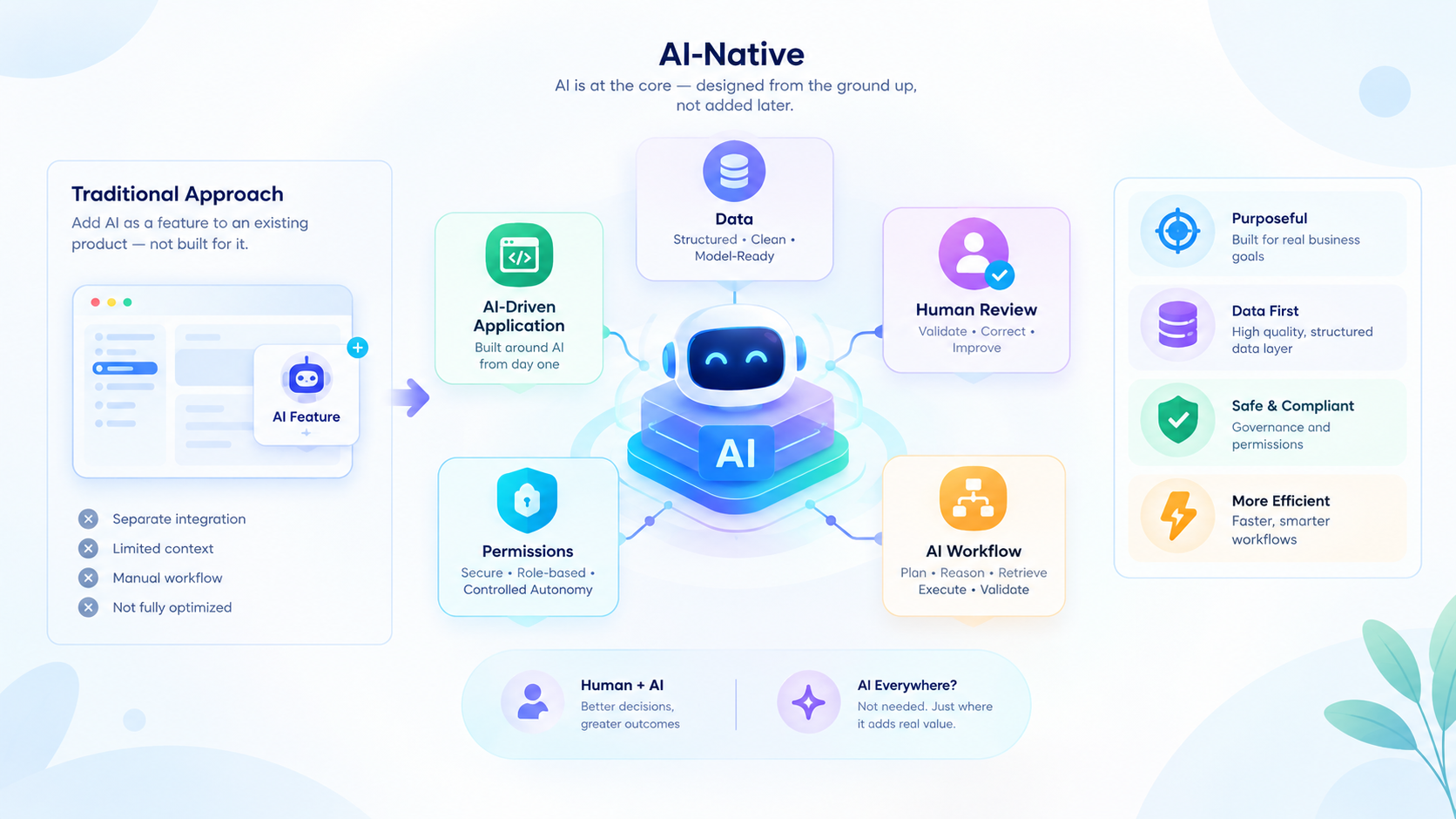
We use "AI-native" a lot on this site, and it's worth actually defining rather than leaving it as a buzzword. It's not just "a product with an AI feature." It's a different starting point for how the whole product gets designed.
Ask this: if you removed the AI feature, would the product still make sense in its current form? If a chatbot bolted onto an existing dashboard disappeared tomorrow, the dashboard still works exactly as it did — that's AI-added. If the product's core workflow, data model, and interface were designed assuming an AI system would be doing part of the work, removing it would leave a product that doesn't really function — that's AI-native.
The data model. AI-native products are usually designed so the data an AI system needs — clean, structured, retrievable — is a first-class concern from day one, not something reverse-engineered from a database built for a different purpose.
The interface. Instead of a chat box tacked onto a traditional UI, AI-native interfaces are often built around reviewing and correcting AI output as the core interaction pattern — because the product assumes a mix of AI and human work from the start.
The permission model. AI-native products design explicitly for what the AI is allowed to do autonomously versus what needs human approval, baked into the architecture rather than added after an incident.
The team's default questions. An AI-native team asks "what should the model handle versus the human" as a design question for every feature, not just for the one feature labeled "AI."
Retrofitting AI-native thinking into an existing product is possible, but it's genuinely harder than starting with it — similar to how retrofitting mobile-responsive design into a desktop-only site built a decade ago is possible, but painful compared to building responsive from the start. If AI is going to be core to how your product works in two years, the earlier that assumption shapes your architecture, the less expensive the eventual transition.
AI-native doesn't mean AI-everywhere. Plenty of well-built AI-native products have entire sections with no AI involvement at all — the term describes an architectural starting point, not a requirement to force AI into every screen.
We treat "should this be AI-native or should we add an AI feature to what exists" as one of the first questions in any AI-related engagement, because it changes the scope, the timeline, and the team you need — and getting it wrong in either direction gets expensive.